Step 5. Practice
Theory without practice is dead. Once you've learned the planets, signs, houses and aspects, start practising on the people you know — friends, colleagues and relatives.
Where to calculate charts
There's no need to calculate anything by hand: charts can be generated online for free. The recommended program is Sotis-Online — a professional tool that runs in the browser and on your phone and produces natal charts, transits and synastry.
To calculate a chart you'll need the date, exact time and place of birth.
A sample natal chart
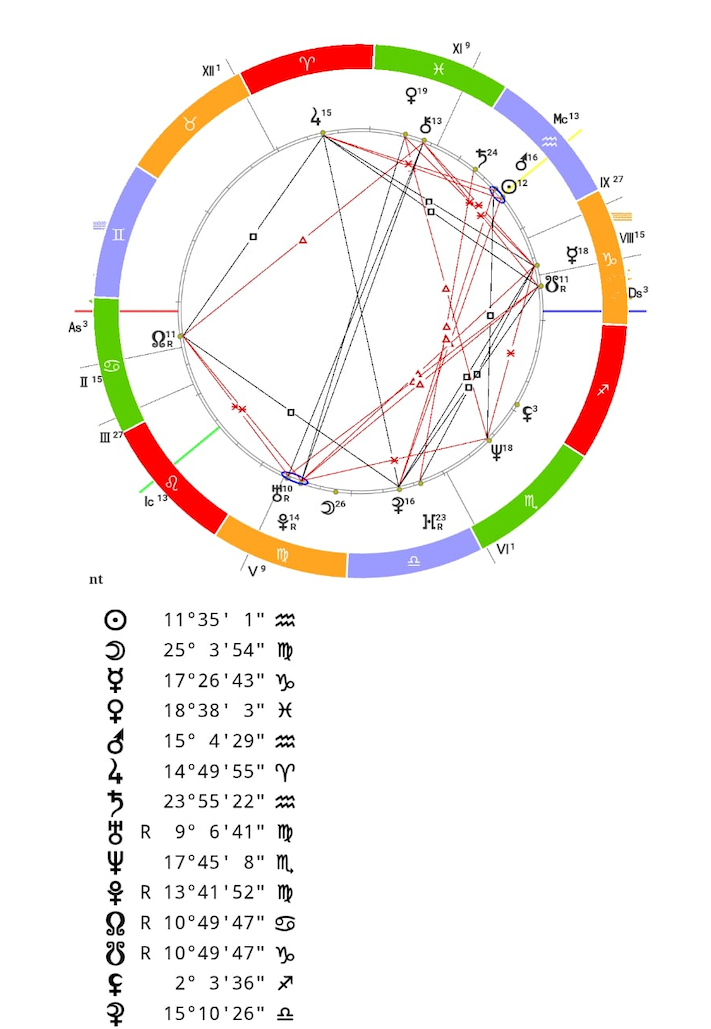
What this example shows and how to read it:
- The Sun ☉ at 11° Aquarius — the core of the personality: independence, originality, a focus on the future.
- The Moon ☽ at 25° Virgo — the emotional nature: practical care, attention to detail and to health.
- Mars ♂ and Saturn ♄ are also in Aquarius, close to the Sun — a heavy concentration of energy in one sign (a stellium).
- The Ascendant (As) in Cancer — how the person comes across and behaves on first contact.
- An R next to a planet means it is retrograde — its energy is turned "inward" and expresses itself with a delay or in unconventional ways.
A practice plan
Draw up your own chart
Start with yourself: nobody knows this "client" better than you, and you'll see right away what fits and what doesn't.Read the charts of people close to you
Friends, colleagues, relatives — 10–20 charts of people you know well. Check what you read against their real lives.Work from the general to the specific
First the elements and hemispheres (where the planets cluster), then the strongest planets and the angles, then the houses and aspects. Don't get lost in the details.Keep notes
Keep a notebook of your readings: hypothesis → check → conclusion. After 20–30 charts you'll start to see your own working methods emerge.
Courses: do you need one?
All the information is freely available, and the plan described here is enough to get started on your own. If you want more structure and feedback, you can take a course. A good example is Konstantin Daragan's Academy of Astrology in St. Petersburg: worthwhile overall, but not essential.
The golden rule of practice: astrology is a tool for understanding, not a verdict. Any configuration can be lived out at different levels — a chart shows potential and challenges, not a fate carved in stone.
Round out the theory with spoken explanations — audio lectures →